


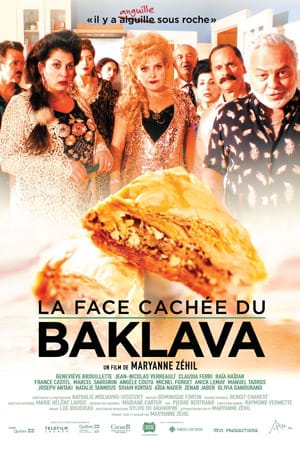
The Sticky Side of Baklava, a comedy about two Lebanese sisters living in Québec, finds humor in culture clashes and the realization that embracing our differences can be as sweet as bite of baklava.
by Doga Usanmaz
See the US Premiere of feature-length comedy The Sticky Side of Baklava on February 23 @6:30 PM at LOOK Cinemas (657 West 57th Street) as part of New York City’s 12th Annual Winter Film Awards International Film Festival. Tickets now on sale!
The Sticky Side of Baklava is a tender comedy that shows the unique ways in which two people can react to living in a culture different from the one they are born into.
Throughout the film, the lives of Houwayda and Joëlle, Lebanese sisters living in Montréal, are turned upside down as Houwayda announces her decision to accompany her Québecer husband in his sabbatical in France.
Joëlle, despite living in Canada, remains deeply in touch with her roots, immersed within the Lebanese community of Québec. Houwayda, on the other hand, appears to have embraced the Québecer-lifestyle. As Joëlle works to make her sister stay, Houwayda is left to contemplate her own internal conflict regarding her Lebanese background and her experience as an immigrant, torn between her two cultures.
“Some people try to get hold of their culture very, very tightly and they become very close to their culture, while some others, on the contrary, decide to let go of their own culture, so they can embrace the new one which they live in. And this is how I saw the two sisters,” said Maryanne Zéhil, the director and producer of The Sticky Side of Baklava.
 Zéhil, who is Lebanese-Canadian, grew up dreaming of becoming a filmmaker. She said that she got her inspiration for the film from the people around her, and by observing the culture-clashes experienced by her friends and family members. She found that the immigrant experience often featured the antagonization of one of the two; the culture that you come from, or the one that you move into.
The film, which was edited on Avid, does explore this clash, especially during a particularly comedic scene where there is mayhem over Houwayda not having arak (a popular Lebanese liquor) in her house, but it doesn’t mean to say one culture is better than the other.
“When you start antagonizing, when you start saying, ‘this is better than this,’ then you are losing the enrichment of it all,” said Zéhil. “The most important thing is to learn that there is another way of seeing things, another way of living life, another way of having fun.”
It doesn’t glorify running away from your own culture either. The title of the film doesn’t merely refer to baklava as a honey glazed Middle Eastern delicacy—occasionally a little too sticky. It references the inescapability of ‘baklava.’
 Houwayda, despite having embraced the Québecer lifestyle, takes on the role of the caretaker for her husband. Zéhil noted how this is “her bringing to that couple her own way of doing things and seeing things,” rather than something that is forced onto her. Throughout the film, Houwayda clashes not only with her own culture, but also with the dynamics of her marriage.
Zéhil emphasized the challenge to find comedians in Québec who have a Lebanese background and added that Claudia Ferri, the actress who plays Houwayda, is actually of Italian descent and that they worked very closely. Zéhil believes in the significance and value of multiculturalism in our increasingly globalized world and she emphasized the fun and the laughter that prevailed on the set of the film, as well as the diverse backgrounds among the cast.
Highlighting the importance of finding humor in our differences, Zéhil said, “The main point is to say that it’s fun to have different people, to share different things, to learn different things, to laugh at them, and to laugh at ourselves, instead of antagonizing and going into war, and deciding to kick them out of of Canada. My dream would be to see that the audience would find it funny and nice to have differences. I just would like them to come out from the theater and if they see different people on the street, they would look at them and smile.”
Doga Usanmaz
Doga Usanmaz is a recent New York University graduate, originally from Istanbul, Turkey. After attending international school in Switzerland, she decided to come to New York to pursue her studies in multimedia journalism and politics. She completed her double major, alongside a minor in creative writing in December 2023. She has previously interned at Cumhuriyet Daily News, a leading Turkish newspaper, and has worked for various NYU publications, such as NYU Local, for which she wrote articles on the arts, as well as the Journal of Politics and International Affairs at NYU. She also recently served as the Video Director of Washington Square News, NYU’s student-run newspaper, where she produced video stories on culture. She is passionate about Middle Eastern politics, writing, and video production.
About Winter Film Awards
New York City’s 12th Annual Winter Film Awards International Film Festival runs February 21-25 2024 in New York City and includes 82 outstanding films, a diverse mixture of animated films, documentaries, comedies, romances, dramas, horror films, music videos and web series of all lengths. Our five-day event is jam-packed with screenings and Q&A sessions at NYC’s LOOK Cinemas, six Education sessions/workshops and a variety of filmmaker networking events all coming to a glittering close on February 25 with our red-carpet gala Awards Ceremony.
Winter Film Awards is dedicated to showcasing the amazing diversity of voices in indie film and our 2024 lineup is 58% made by women and half by or about people of color. Filmmakers come from 23 countries and 41% of our films were made in the New York City area. 13 films were made by students and 26 are works from first-time filmmakers.
Winter Film Awards programs are supported, in part, by public funds from the New York City Department of Cultural Affairs in partnership with the City Council and are made possible by the New York State Council on the Arts with the support of the Office of the Governor and the New York State Legislature. Promotional support provided by the NYC Mayor’s Office of Media & Entertainment.
Visit https://winterfilmawards.com/wfa2024/ for more information.


