


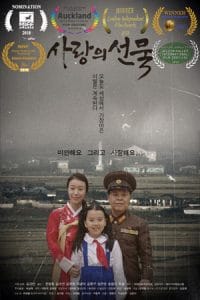
The most painful thing is that many people turn away from the numerous deaths in North Korea, says North Korean defector filmmaker Gyu-min Gim who lived contemporaneously with them and witnessed many deaths. Mr. Gim spoke with Winter Film Awards’ Youlim Nam about his film The Gift of Love.
See the New York City premiere of “The Gift of Love” on February 16, 2019 @3:45 at Cinema Village (22 East 12th Street) as part of New York City’s 8th Annual Winter Film Awards International Film Festival.
Q. What did you want to create ‘The Gift of Love’?
The biggest reason why I created the movie “The Gift of Love” (Series of Winter Butterfly; second story) is for North Koreans dying in the cursed North Korean land even at this very moment. Media around the world paid attention to the story of the death of Kim Il-sung and Kim Jung-il, but only a few people talked about the millions of North Koreans who have died because of them. So I wanted to talk about this matter because I lived contemporaneously with them and witnessed many deaths.
Q. I assume you might have a lot of inner struggle thinking about people who are suffering in North Korea when you produced this film as a North Korean defector. If you have any related stories, could you share them?
The most painful thing is that many people turn away from the numerous deaths. In particular, North Korean human rights in South Korea are stigmatized as anti-Korean reunification sentiment. Even though numerous people in North Korea are still dying under the feet of the dictator Kim Jong-un, many people don’t care about them and are doing their utmost to calm and save the North Korean government; It was painful for me.
The most painful is that North Koreans who have the strength to live life to the fullest cannot do anything but live with death and famine. This reality is not because they don’t want to work. They are not allowed to work; that makes my heart pained every time I film a part of the series of ‘Winter Butterfly.’
As you can see in the film, the main male character must be loyal to the country because of the irrationality of the dictatorship system of North Korea even though all he wants is to live for his loving his wife and daughter. That reminded me of my past which made me very frustrated.
Q. Could you briefly explain ‘The Arduous March’ and the ‘Self-Reliance Movement,’ the background of the movie’?
‘The Arduous March’ is the North Korean great famine that started in the mid-1990s. Self-Reliance is to be loyal to the country although they have to pull themselves up under deplorable conditions without any support from the government.
Q. I wonder what it was like to communicate with actors. I assume it was not an easy process for the actors to portray North Korean’s real life. How was it like to develop the characters with them?
It was not easy for the actors who have never lived in North Korea and have never experienced famine to portray the life of North Koreans who only know suffering from their birth. However, they did an excellent job by continually communicating with me and learning about North Korea life.
Frankly, I was more upset when an actor who promised to perform had to turn down the role because of her management company. The reason is that if the actor appears in a movie about North Korean human rights, it will hinder her getting cast in the next film.
Q. I assume all of the shooting locations are in South Korea. Did you have any difficulties scouting locations?
It was very challenging to find the right locations because of the particular circumstances of North Korea. I looked around everywhere in South Korea for months to get just a place like a brothel. In the end, I had to create most of the locations as a film set. I built the sets myself because I did not have enough budget.
Q. What was the happiest moment in the production process?
All filmmakers probably feel the same way; the moment I started filming the very first scene after all the trials, and when the film met the audiences for the first time.
Q. Could you give me a brief introduction about the next film?
I’m working on my next project ‘Winter Butterfly’ – the third story of the series ‘Trial Case’ (Working Title). This work is also based on the true story of North Korea. It’s a story of an old man in North Korea who lost his children and lives with his young granddaughter.
Q. Lastly, do have anything you want to tell the New York audience?
Many people’s eyes are now on the second US-North Korea summit. However, even if the desires of the United States may be resolved after the 2nd, 3rd and 4th Summit, Kim Jong-un’s dictatorship will still be in place, and that will lead to the death of countless North Koreans.
Please do not forget the North Korean people who are dying in Kim Jong-un’s dictator regime.

Youlim Nam
Youlim Nam was born and raised in Seoul, Korea. Youlim is an International actor and playwright. Her short plays (28+2, A Watch, Just B’day in NYC, etc.) have been actively produced at off-off broadway theaters, such as the Secret Theater, Manhattan Rep Theater and HB Playwright Theater. Her short film Acting Is My Destiny, written, directed, performed by her, garnered great attention at many independent film festivals as well as being honored with the ‘Best Actress’ award at the International Independent Short Awards and ‘Best Monologue’ award at Actors Awards, LA. During the pandemic, she opened her short play podcast ‘No Pressure, it’s just a short play podcast’ to stay connected with theater audiences. Youlim is a member of Dramatist Guild of America.
About Winter Film Awards
New York City’s 8th Annual Winter Film Awards International Film Festival runs February 14-23-2019. Check out a jam-packed lineup of 89 fantastic films in all genres from 32 countries, including shorts, features, Animation, Drama, Comedy, Thriller, Horror, Documentary and Music Video. Hollywood might ignore women and people of color, but Winter Film Awards celebrates everyone!
Winter Film Awards is an all volunteer, minority- and women-owned registered 501(c)3 non-profit organization founded in 2011 in New York City by a group of filmmakers and enthusiasts. The program is supported, in part, by public funds from the New York City Department of Cultural Affairs in partnership with the City Council and the NY State Council on the Arts.


