


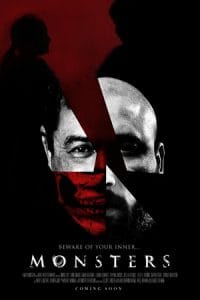
A riveting, on your seat, action film, Monsters explores some pertinent themes including: the abuse of patriarchy, the sanctity of matrimony, and finding and holding onto true love. Enticing, provocative, and action-packed, feature film Monsters’ underlying dark message tests the limits of love. From the first scene we’re not sure whether to brace ourselves for a cliche coming-of-age drama, or to expect something else. See the New York City Premiere of Monsters on Sunday Feb 17 in the 9:15pm -12:00am screening block at Cinema Village (22 East 12th Street) as part of New York City’s 8th Annual Winter Film Awards International Film Festival.
In the onset of Monsters, there are some anticipatory religious undertones, as the camera scans Muslims in prayer at their mosque. But once three men in skeleton masks raid a family’s home, the idea of a higher deity is pushed to the back burner and faith in the nature of humanity is pushed aside and questioned. As the masked men playfully abuse both mother and daughter, one gently and calculatingly slides his knife against her bosom and the other two stand guard, one laughing and the other baffled by the cruelty of his partners.
 Among the “monsters”, one of them is morally uncertain about what they’re doing to the family, docile in nature, so it may seem initially. His troubled conscience causes his continued uneasiness; it’s this character who we equally pity and grow to like. When the man of the house returns home to see his wife and daughter bound and tied, the father feels like he can convince them to release them by flashing cash around. Isn’t valuing money above all the answer? Soon, they discover there’s so much more they want from him and it’s those family secrets that come to the surface later on.
The film gets increasingly heated as the family continues to suffer under the wrath of the “monsters”. Violence, unconsenting sexual abuse, emotional turmoil; the three masked men keep digging for continued emotional reaction from the family, hoping that the abuse and torture will get them to open up about where the safe is. But if that’s all they were there for, the film would be just another generic action film. Coming to this home, why they chose this family and who they were is unclear, yet clarity is later discovered.
 As the story unfolds, we are reminded that one’s brokenness can often manifest into an uncertainty of life. Not knowing how to handle deep emotional pain, a monster can be birthed, seeping into the consciousness, yet not disrupting the conscience. When we are overtaken by the monsters of our past, we hold onto the person we think we are; regardless if what we do in response is ethical. The film explores the ethics of relationships, the pain of loss, and why we need to hold onto our history. The unfulfilled dreams of our childhood become the monsters that haunt us, and through the protagonist’s flashbacks, he soon realizes he was the one holding the knife all along.
Was there a particular event in your life that inspired the film?
A true event inspired the birth of Monsters. Few years ago, I read an article of a housemaid that was almost beaten to death by her employers. That event triggered investigations and more stories about maid abuse in the newspapers. Reading all those painful stories made me want to shed a little bit of light into the issue. That’s how Monsters was born.
 How did your view on patriarchy affect the plot of the film?
I grew up in a patriarchal society and I have been in many situations where the smartest person in the room was a woman; however, they did not have a voice and were always shut down by the male just because of their gender. Many times that smart woman in the room was my own mother. In the Monsters’ dialogue a lot of offensive language stemmed from my memories of men using that vocabulary against women. Hoping that if I could make people recognize through characters what they say and do to their wives and daughters, maybe they would see themselves in a different light and maybe just maybe think twice about their behaviour. I believe that no society can move forward without being able to look at itself in a mirror and self criticize. And art can be that mirror.
What was the significance of the first scene of the father praying at his mosque and how was it relevant to the storyline?
In my country religion is part of who you are. People who go to the mosque are trusted and respected more than the ones who don’t, to a point were many men grow beards and make sure to go to the mosque five times a day and be seen by others because it could be good for their business.
The first scene was designed for two purposes, one to introduce the father to the audience as a man of faith and a respectful man in the society. Two, make the audience ask questions: is he really who everyone thinks he is? I hope I succeeded in that.
What in your mind would you consider makes or turns someone into a “monster”?
Honestly, I can’t presume to know the answer to this question. In my movie, we know what made the character turn into a monster, however, it’s hard to determine what could make any of us turn into a monster in real life. It could potentially be anything, e.g. loss of hope, seeking revenge, suffering from injustice, mental illness. It is like the old Cherokee story of the two wolves inside of us, the bad and the good, it depends on which one we feed and take care of, that’s the one that would win.
 What is your view on class divide and how did you try to illustrate this in the film?
I think it is a crime someone gets to collect jets or houses while millions of human beings are dying because they don’t have food, or access to clean water or health care or even education that might provide them with a chance to improve their situation one day. And the worst part is that many of the so called “higher class” are getting their toys by killing our planet. I tried to illustrate the class divide in the movie by showing the differences between the maid and her employers, through their needs and wants and how they go on to get them.
How long did it take you to film?
We filmed the movie in 15 nights and 3 days. With the exception of the exteriors, all the interior days in the house were shot at night. Because there is a mine near where we were shooting and they use explosives to blow up mountains during the day, the only way to get clean sound and avoid dubbing the whole feature was to shoot at night.
 What were some challenges you encountered during the creative process?
I encountered many challenges then that I now see as great lessons. The first challenge was in the writing process. As a writer/director when I write I am already thinking about the staging and the shots. In the first five drafts I was planing to shoot the movie as one long take. The more re-writes I did the more I started to have doubts if that was the best way to tell my story, however, it was really hard to let go of the long shot idea. The second challenge was loosing one of the main actors ten days before we started production and after we had already rehearsed for two weeks.
The third challenge was to shoot without a budget. Many days we were not sure if we would be able to shoot the next day because we wouldn’t have access to a location or we would be missing set furniture. To add, I didn’t have any money for post-production, so I had to figure out how to pay for music, color, sound, studio, etc.
The fourth challenge was discovering six months after having shot the movie that we had lost footage of the last day of production. I had to find the money to fly to Morocco to re-shoot, to convince one actor to gain weight and another to shave all his hair again and grow a beard, and get the permits for the shooting. To add to it I was the only crew member. The best part of all those limitations was that they all helped me become a better filmmaker.
 What advice would you give to filmmakers trying to come up with a compelling storyline?
I don’t believe there is one specific way to come up with stories. I think it is different for each person.
However, it is hard for me to imagine myself writing about things I don’t care about. So I would say look inside of you, then look around you. What bothers you? What makes you happy or angry? And then write about that. Also it goes without saying that we need to read as much as we can about things that are not related to filmmaking, have new experiences, learn new things, travel.
How did you come up with the surprising plot twist?
The twist was not there in the first five drafts of the script. Once I started reading the fifth draft to get myself ready to re-write once again, I started asking question such as “what if? what if this character was part of this or what if the scene was about something else.” I kept trying different ideas and then one day my wife, my kid and I were driving to Costco and it just hit me. I guess my subconscious came up with the idea and I wrote it.
What is your favorite aspect of being a director? What part of the process do you like most?
It is very hard to choose as there are so many reasons why I like directing. I love creating shot-lists and converting words into images. I love the collaborative process of creating a different visual language for different stories. I love the collaboration with the actors and how they can bring life to words. It’s all so magical. I love editing and how we can re-write scenes by changing the shots and the meaning along with them. I would say I love everything about directing.

Alexa Modugno
Alexa Caroline Modugno is a NY based arts writer, model, actress and talk show host. As a graduate of NYU, she majored in viola and as a violist, she performs with the Strange Walls throughout NYC. She is passionate about foreign films, fashion, art and NYC culture.
About Winter Film Awards
New York City’s 8th Annual Winter Film Awards International Film Festival runs February 14-23-2019. Check out a jam-packed lineup of 89 fantastic films in all genres from 32 countries, including shorts, featuers, Animation, Drama, Comedy, Thriller, Horror, Documentary and Music Video. Hollywood might ignore women and people of color, but Winter Film Awards celebrates everyone!
Winter Film Awards is an all volunteer, minority- and women-owned registered 501(c)3 non-profit organization founded in 2011 in New York City by a group of filmmakers and enthusiasts. The program is supported, in part, by public funds from the New York City Department of Cultural Affairs in partnership with the City Council and the NY State Council on the Arts.


