


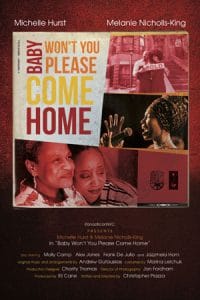
It’s true what they say about music. It hits you. The film Baby Won’t You Please Come Home illuminates the heart wrenching effects of a retired jazz singer’s battle with senile dementia that robs her of her memory, but never her dignity. See ‘Baby Won’t You Please Come Home’ on Saturday February 16 2019, in the 9:15pm -12:00am block at Cinema Village (22 East 12th Street) as part of New York City’s 8th Annual Winter Film Awards International Film Festival. Winter Film Awards’ Lianna Albrizio recently spoke with director Christopher Piazza about the film.
Unable to sleep, Pearl Simmons (Michelle Hurst, Orange is the New Black), an elderly woman fighting the early stages of Alzheimer’s disease, stares at the ceiling fan in her bedroom that is moving around like a record player above her body. The gentle sounds of imaginary jazz music drown out the faint noise of her daughter and son-in-law who are heard from the kitchen bickering over Pearl’s recent curious behavior, and she dozes off.
In her reverie, a woman appears onstage in a club circa the 1970s as music wafts from a cello, saxophone, and drum-infused backing band and smoke fizzles from the ends of cigarettes. It’s her. A young, lauded jazz singer (Jazzmeia Horn) dressed in African garb croons a wistful, familiar song from her red lips that rings hauntingly true today: Bessie Smith’s “Baby Won’t You Please Come Home.” She sings every verse more impassioned than the last:
 Baby won’t you please come home/’Cause your mama’s all alone…/When you left you broke my heart/That will never make us part…/
Flash-forward to the present day, Pearl lives with her daughter Cynthia (Melanie Nicholls-King, The Wire) in a wooden, red-walled Brooklyn apartment remodeled in the good old days by her husband’s bare hands. One sunny morning, Pearl stares at her reflection in the mirror. Wearing a dress and matching sunhat, she purses her rouge lips with a satisfied smile. But she only sees what she wants to, and ignores the reality of her condition that creeps up like a monstrous shadow bringing with it hallucinations, self-injury, forgetfulness and frightening confusion.
As Pearl’s memory disintegrates and her beloved home becomes a hotbed of stress, a pushy realtor (Molly Camp, Gotham) making sales on her block proposes a hefty offer for her priceless abode. While Pearl struggles to lead a normal life, she clings to her fragmented memories as both a doting mom and sensational singer – the only truths that give her spiraling life any factual soundness and happiness.
Director Christopher Piazza’s use of jazz music as the backdrop makes this pearl of a film bleed poignancy. Baby Won’t You Please Come Home shines a bright stage light on the heart wrenching effects of senile dementia that robs the sufferer of her memory, but not her dignity.
 Lianna: The film centers on an aging woman – once a beautiful jazz singer – fighting Alzheimer’s disease. It’s scientifically proven that music therapy helps Alzheimer’s patients recall memories. Is that why you wanted to make the film?
Christopher: Music can be a grounding influence to people suffering Alzheimer’s disease. It can orient them and clarify memories from a certain time period, which is exactly how the music scenes function in Baby Won’t You Please Come Home. In the film, former jazz singer Pearl often escapes into happier memories, and these memories are recalled through music.
Lianna: Did you know anyone personally that has been touched by Alzheimer’s disease that may have also contributed to you wanting to make this film and understand the disease better?
Christopher: Alzheimer’s runs on my mother’s side of the family – my grandmother, grandfather and uncle were all affected by Alzheimer’s and dementia. It’s a disease that affects so many families and yet is still so poorly understood and under addressed. I wanted to make this film not only to raise awareness about the disease, but also to put the audience into the point of view of the person suffering from it.
Lianna: How did you envision jazz music for this film? The lead singer could have been sung any genre. Did you feel it was more romantic and wistful to center on jazz from a director’s perspective?
Christopher: The film is very New York specific and jazz is a very New York genre. There’s something about the passion and spontaneity of jazz music that lent itself well to the emotions – wistfulness, love, confusion – that the main character goes through in the film.
 Lianna: Why did you feel Michelle Hurst was good in the lead role? Have you worked with her previously?
Christopher: I hadn’t worked with Michelle before but I wrote the script with her in mind. I loved her performance in Orange is the New Black and was particularly struck by how effectively she could switch between maternal sweetness and frightening intimidation. The mood swings that Alzheimer’s patients experience can be extreme and sudden and I knew Michelle could be great in the role. Her performance in the film is amazing and I feel lucky to have worked with her.
Lianna: There have been many films about Alzheimer’s disease: Nicholas Sparks’ The Notebook and Richard Glatzer and Wash Westmoreland’s Still Alice. In your film, the protagonists had led extraordinary lives in finding lasting love and success in booming careers. It’s particularly a travesty when the person later on in their life develops Alzheimer’s and their wonderful memories are disintegrating. Is that another reason why you wanted Pearl to have a career as a lauded jazz musician?
Christopher: One of the most heartbreaking things about Alzheimer’s disease is that it robs people of their memories, and the sum total of our memories constitutes most of what we think of as our “self.” Our families, our jobs, our life experiences – these are what make us who we are. The character in the film was a famous jazz singer, but this is not a disease that discriminates between rich and poor, famous and ordinary. It can affect everyone, and for anyone to lose their sense of self to a disease is tragic.
The biggest thing I’d like for people to take away from this film is that, if they have experienced Alzheimer’s disease with a loved one, they are not alone and they can share their stories. In the film, the mother and the daughter characters deny the obvious signs of Alzheimer’s until its too late. I hope after watching this film, families who are affected by Alzheimer’s will talk more honestly amongst themselves about care options, but also share their stories with others to raise awareness about the disease.
 Lianna: Throughout the film, it seems Pearl’s daughter has no idea what her mother has. Were you trying to also illustrate the heartbreak associated with seeing a loved one exhibit odd behavior and the enigma and heartbreak of trying to decipher what a loved on is suffering from given all their symptoms? I saw, for instance, some self-injury, wandering and getting lost, hallucinations, etc.
Christopher: Alzheimer’s is such a scary disease, and one that can come on very slowly. Because of that, family members and even patients themselves can live in denial for a very long time that Alzheimer’s is affecting them. In the film, I think both Pearl and her daughter Cynthia are so afraid of the truth of Pearl’s condition that they’d rather deny it than confront it, but the reality of the disease overwhelms them eventually.
Lianna: Did you learn anything yourself from making this film? What did it teach you?
Christopher: What I learned after making this film and watching it with audiences at film festivals is that many, many families have stories like this and often they haven’t shared them. People have come up to me, my cast and crew after every showing of this film telling us how the film so accurately reflected what their families went through and, oftentimes, that they had never told anyone about their experience. I know that Alzheimer’s affects many people but the amount of people who told me about their experiences was a real surprise to me.
Lianna: Lastly, as far as camera equipment, what special tech did you use to make this film if any, and how many days was it shot in?
Christopher: We shot the main part of the film in three days, and all the jazz scenes with a live band another day. We shot on the Arri Alexa Mini camera. I want to give a shout out to DP Jon Fordham and his fantastic lighting and camera team for making this film look absolutely gorgeous.
https://vimeo.com/243861794

Lianna Albrizio
Lianna Albrizio is a seasoned journalist and editor passionate about covering all facets of the arts from film to books, music and food. She loves interviewing people and spreading the word about their amazing work for all to enjoy.
About Winter Film Awards
New York City’s 8th Annual Winter Film Awards International Film Festival runs February 14-23-2019. Check out a jam-packed lineup of 89 fantastic films in all genres from 32 countries, including shorts, featuers, Animation, Drama, Comedy, Thriller, Horror, Documentary and Music Video. Hollywood might ignore women and people of color, but Winter Film Awards celebrates everyone!
Winter Film Awards is an all volunteer, minority- and women-owned registered 501(c)3 non-profit organization founded in 2011 in New York City by a group of filmmakers and enthusiasts. The program is supported, in part, by public funds from the New York City Department of Cultural Affairs in partnership with the City Council and the NY State Council on the Arts.


