


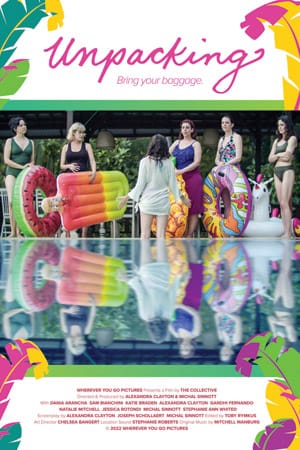
Six American women, sold on the promise of radical transformation, travel to Bali into the hands of an influencer guru and her Indonesian assistant, and get slapped with reality: change is messy AF.
by Whitney Larkins
See the feature film Unpacking on February 22 @6:30 PM at LOOK Cinemas (657 West 57th Street) as part of New York City’s 12th Annual Winter Film Awards International Film Festival. Tickets now on sale!
Whitney Larkins: “Unpacking” takes place in Indonesia. Why this particular location? Did either of you have something transformative happen there?
Michal Sinnot: The inspiration came from a trip when Joseph Schollaert (our 3rd writer) and I visited the year before. I was really struck by Bali. It’s a spiritual place that’s 95 percent Hindu. I found it to be a very open, connected, and joyful place and thought it would be a beautiful place to make a movie.
Alexandra Clayton: Bali has natural beauty and is one of the main ‘wellness meccas’ in the world. People from all over flock there for yoga, meditation and wellness retreats. We didn’t know, until we chose Bali as our location, that the film would center on wellness tourism. Making a feature film is a transformative experience so Bali is a singularly special place to both of us now.
MS: If you ever visit, we can’t recommend our fellow producer, fixer, and driver enough. ‘Yadi Tour’ (findable on FB) is your guy!
In this film you both act as Writer-Producer-Director-Actor multi-hyphenates. What were the ups and downs of learning experiences that you had from these roles?
 MS: We had a very successful partnership. But I don’t know if I want to wear that many hats again on the same project. Acting is my first love, but I love multi-hyphenate work. I like shepherding a project up until production as a writer/producer and then retreating into my work on set as an actor. I may direct again, but I might also be okay with only having a significant hand as a writer/producer and having someone else have the final say. I’ve learned that I’m a storyteller through this process.
AC: It was a lot of hats! I truly love directing and this experience really solidified that as my creative driving force. I also identify as a true multi hyphenate, and love creative producing and co-writing, there is something juicy and exciting about each aspect. Michal, Joseph, and I worked really well as collaborators in that realm. And as an actor, I also learned I prefer when someone other than me is in the director’s seat. I would not do another project without a dedicated producer and AD to support the process though!
You mention in the film that women are culturally programmed to be self loathing- and that isolation is at the heart of a lot of strong, independent women’s unhappiness. Can you speak to these themes?
AC: I mean we are, right? A driving force of capitalism and the patriarchy is teaching women that we’re not enough– so we waste our time and money on superficial pursuits to please these constructed/oppressive ideals of ‘femininity’ and ‘beauty’– it holds us back from leadership and deeper development. Wellness tourism may be rife with many of the same hypocrisies but it’s also attracting people actively seeking growth. That’s what we set out to explore.
MS: And for a long time, we bought into that same construct that there wasn’t enough room at the table for all of us. Women have to continue to move from a culture of competition and into one of support for one another. All boats rise with the tide. Female friendship is a big theme of the movie. How do we connect in the midst of our differences? How do we truly champion each other?
 AC: Female friendship is powerful. Life is better when you’re not alone.
There was a discussion about cultural appropriation in the film. You admit that you felt there could be more diversity in the cast. How did you approach this sensitive subject?
MS: This was not a traditional approach to making a feature. The story and characters were born from the large group we approached. We sent out an email to a diverse group of 40 of our friends and colleagues asking if and how they might want to be involved. The people who wanted to act were all white women – which made the idea of centering it on a wellness retreat obvious. We then rounded out the Indonesian cast with Gandhi Fernando, a friend and actor who lives in Jakarta and Dania Arancha, an actress that he had worked with who lives in Bali.
AC: We then asked our performers to do ‘wellness retreat’ submissions in character, highlighting a close to the bone issue they wanted to explore. Their stories/characters were the first seeds of the film. All the stories of the characters involved bigger issues which we pushed as far as we could without being didactic and also leaving room for laughs.
MS: Cultural appropriation is cringey and uncomfortable and we wanted to address it head on. A good film makes us think and it was important for us to have the discussion there, to have accountability in these spaces. It would have been obtuse or egotistical for us not to address it. Wellness retreat participants are, for better or worse, mostly white women.
The unrelenting pressure to succeed as women and “Imposter Syndrome” were addressed in the film. Are women putting too much pressure on ourselves to succeed?
MS: Sure. I think we have to look at social media. We don’t really see anybody’s life online as it truly is.
AC: No one is immune to Imposter Syndrome.
MS: It’s all wrapped up in our sense of our own worthiness. I think it’s also due to cancel culture– there’s this lens ready to publicize any missteps. It’s important to try to be a good human, but we all mess up.
AC: We have to allow people to grow and to learn from making mistakes.
 What would you suggest for women who would like to do something similar to what you’ve shown in “Unpacking” but are unable to travel to a distant location for this type of wellness retreat?
MS: Join women’s circles, or 12-step programs. Most communities will have some form of these and they’re usually free.
AC: There’s also often meditation and yoga centers if that calls to you. There is a hypocrisy in wellness tourism because you have to spend a lot of money to travel and it’s not always equally accessible.
You mentioned previously that there were major challenges to the making of this film. Would you like to elaborate on what exactly happened?
MS: I was diagnosed with cancer three weeks before shooting. We added that situation to the Charlotte character because I didn’t want to have to mask these complicated emotions on set as a director/actor. I had major surgery three days after returning from shooting. The growth returned a year a half later. The pandemic happened. Our Assistant Director got dengue fever and almost died but thankfully made a full recovery. It was an endurance test making this movie. I feel so lucky to have met Alexandra and to have built community with her.
AC: Also, post-production was challenging as we were suddenly living on opposite coasts and dealing with time zone issues, etc. Due to the pandemic, we had to work with all our Post collaborators remotely- never getting to be in the room together is tricky and slow going.
“Unpacking” has many opportunities for self-reflection and reflection of society. What are some additional takeaways or nuggets of wisdom you’d like your audience to come away with?
MS: I wanted the audience to have fun and hopefully to make them think. We wanted to connect with other women and allow them to lose themselves in something scary/unfamiliar – but they’re going to grow from it. Also, every piece of art should be a risk. And say yes to the adventure!
AC: In the first few minutes of the film, you might be unsure of what is happening, but allow yourself to let go and journey with the women. Making this film taught me so much about collaboration and the process of discovery. Be open to discovery.

Whitney Larkins
Whitney Larkins currently works for a media company and has a degree in Radio/TV/Film as well. She wrote her Master’s thesis on film representations of immigration in 20th Century American film.
About Winter Film Awards
New York City’s 12th Annual Winter Film Awards International Film Festival runs February 21-25 2024 in New York City and includes 82 outstanding films, a diverse mixture of animated films, documentaries, comedies, romances, dramas, horror films, music videos and web series of all lengths. Our five-day event is jam-packed with screenings and Q&A sessions at NYC’s LOOK Cinemas, six Education sessions/workshops and a variety of filmmaker networking events all coming to a glittering close on February 25 with our red-carpet gala Awards Ceremony.
Winter Film Awards is dedicated to showcasing the amazing diversity of voices in indie film and our 2024 lineup is 58% made by women and half by or about people of color. Filmmakers come from 23 countries and 41% of our films were made in the New York City area. 13 films were made by students and 26 are works from first-time filmmakers.
Winter Film Awards programs are supported, in part, by public funds from the New York City Department of Cultural Affairs in partnership with the City Council and are made possible by the New York State Council on the Arts with the support of the Office of the Governor and the New York State Legislature. Promotional support provided by the NYC Mayor’s Office of Media & Entertainment.
Visit https://winterfilmawards.com/wfa2024/ for more information.


