


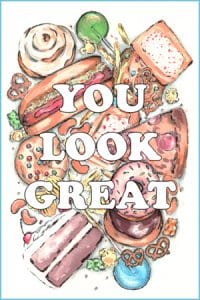
Body image, isolation, and obsessions – an underrepresented story of a man struggling to hide his unhealthy eating behavior. The director of You Look Great, Justin Andrew Davis, explained in an interview to the journalist, Despina Afentouli, how his personal experiences with eating disorders motivated him to produce, write, and lead his debut short film.
See the World Premiere of ‘You Look Great’ on February 16, 2019 @3:45 pm at Cinema Village (22 East 12th Street) as part of New York City’s 8th Annual Winter Film Awards International Film Festival.
What inspired you to write a story about eating disorders? Is it based on a true story?
You Look Great is based entirely on my personal experiences with eating disorders. The history of where it came from is too long to delve into here, but I spent years punishing myself by chasing idealized bodies and media-approved standards of beauty. At some point, I was too mentally and physically exhausted to maintain such a demanding, destructive lifestyle. Every superficial “accomplishment” was fleeting happiness, immediately replaced by another flaw that needed tending to. It took years of quiet suffering and denial, but eventually I was able to reach out and ask for the help I needed in order to move forward. This film is the direct result of admitting to and embracing the pain I fought so hard to keep secret. Once I was able to open up and share my experiences, I quickly learned that my thoughts and feelings and insecurities were more universal than I’d ever imagined — and that I could use creative storytelling to convey them in such a way that even more people could see themselves represented, too.
 In your film, you encourage viewers affected by eating disorders to visit the National Eating Disorders Association (NEDA). How important is to deal with mental and physical illnesses, such as eating disorders?
Before we can be our best, healthiest, most authentic selves, I believe it’s crucial to take time to recognize, name, and accept the pain in our lives. Eating disorders made me a dutiful flaw-seeker, and I suffered tremendously every day that I refused to acknowledge it, expending all of my energy on obsessive, isolated cycles of body-checking, starving, over-exercising, binging, and purging. There was no time for love or friends or enriching my life in real, meaningful ways. A deep sense of shame and a deep sense of control kept me from getting the help I desperately needed, but once I started having hard, honest conversations with my friends and family (and eventually my peers on social media), I came to realize that I wasn’t alone in my suffering. That others shared the very same hurt and the very same struggle to get a hold on it. I saw my own story reflected back to me and it gave me such a rush of human connection, a swell of hope. Previous generations have upheld the foolish belief that issues with mental health are a private affair, as well as a fault. But I think today’s voices are clear: asking for help is not only a sign of strength, but also the first step toward healing.
What is the message you want to convey through your story?
It’s my sincerest hope that You Look Great demonstrates our country’s need to talk openly and seriously about mental illness — how it doesn’t discriminate against age, race, orientation, or class and how shame plays a significant part in why people don’t seek treatment. I want people to know that anyone can be affected and that it’s not their fault if they are; it has and will never be a question of laziness or sheer force of will. Mental illnesses are medical conditions that require attention like any other ailment, and just as you’d go to an orthopedic for a torn rotator cuff, or a cardiologist for a heart arrhythmia, there are professionals trained to diagnosis and treat thoughts, feelings, and behaviors that have physical repercussions and that are harmful to your quality of life. You wouldn’t feel shame taking insulin for diabetes, so going to therapy or taking antidepressants shouldn’t be any different.
 In your opinion, to what extent does body image affect self-esteem?
I’ve come a long way, but there are some times when I stare too long in the mirror and what I see will determine my mood for the rest of the day — which is to say body-image still affects my self-esteem more than I want. Obviously, my response is personal to me, but I’ve experienced many of my peers beating themselves up if they haven’t gone to the gym in a week, or if their hair isn’t cooperating the way they’d like, or if their favorite shirt is suddenly too tight. Media plays a large part in this — between what body types are most prominently displayed and what body types are most openly referred to as beautiful. When the average body is an outlier, we start to feel less-than, deficient. A movement of body acceptance and body positivity is on the rise, and it’s my hope that prioritizing character, knowledge and skill, kindness, and empathy will help usher in a change in what comprises self-worth and self-esteem.
The Hippocratic philosophy was mainly based on “Healthy mind in a healthy body”. What do you think about it?
The single best thing I’ve done for myself was getting back into weekly therapy after years away. Without addressing my pain and trauma in a safe, non-judgmental environment, I wouldn’t have been able to identify the severity of my depression and anxiety, their origins, and whether or not my own interventions would be enough to help me overcome. This ultimately lead me to recognize I needed further help, and so I sought the advice of a psychiatrist. After a formal diagnosis and treatment plan, everything changed. Between the weekly work with my incredible therapist and the proper medication, my life moved forward in a breathtakingly positive direction. I simply couldn’t believe it: on a day-to-day basis, I was operating in an engaging, productive, emotionally stable way, leading me to not only healthier relationships with exercise, food, and my body, but also relationships with family, friends, and significant others. Health means balance, and just as you’d do cardio or lift weights at the gym, you must also take time to workout the various emotional muscles of your mind. Simply put, a healthy mind helps bring about a healthy body, and vice versa.
 In addition to writing the script for your film, you were also the director, the producer, and the lead actor. What was the most challenging part of making that film?
You Look Great was a trial by fire in a lot of ways, seeing as it was my first project as a filmmaker. That said, producing was easily the most difficult part of making this film. Following a short break post-crowdfunder, I realized that I needed someone with know-how to make sure I didn’t lose my mind in a mountain of logistics. I was already wearing so many hats between writing, directing, and acting, and so for the creative integrity of the film, I needed someone who could both help lighten the load and teach me the ropes along the way — which is where Tessa Byford comes in. I am forever grateful that our mutual friend Gabby introduced me to Tessa, the driving force of a producer who brought You Look Great into production (and who also played Sarah in the film). Location managing, cast and crew scheduling, acquiring insurance, budget maintenance, and equipment and transportation rentals are just some of the administrative work she helped me learn, organize, and streamline. Her patience with as me I went along and her confidence in the story are truly the backbone of this film, and I can say without question that she is the sole reason I will be a more efficient filmmaker and a better collaborator.
 How long did it take to produce the film?
If we consider the start of producing all of the prep work for the crowdfunder, it took us close to 10 months to get to production. Between raising money, the much-needed hiatus that followed, several change-ups in cast and crew, location scouting, and balancing the schedules of sometimes 20+ people, it to us longer than anticipated to get to our first shoot day. It’s all a process, but I honestly wouldn’t have sped it up a single second for the incredible film we were able to walk away with.
What does it mean to you to make films that matter?
Films that have resonated with me most are ones that make me go “I’ve had that conversation,” or “I’ve been in that relationship,” or “I know that feeling, that situation.” Even if it’s challenging subject matter, I find great human comfort and satisfaction when films act as mirrors, no matter how chilling and revealing they may be. I live for kitchen-sink realism and warts-and-all character portraits and that moment when stories feel so true it’s like the writer consulted me and my own life. I want my films to examine the darker, tender parts of life — the heartbreaks, the depressions, the private tragedies that yearn for public catharsis. Anything people think we’re supposed to tuck away and hide. With that in mind, two women came up to me after a private screening of You Look Great, smiling and half in tears, and thanked me for “being brave” and representing their stories on-screen in a real, uncensored way. You can’t believe how touching this was. I gave them each a hug and said to myself: this is the kind of work I want to spend the rest of my life making. And then burst into tears myself.

Despina Afentouli
Dr. Despina Afentouli (www.afentouli.com) is a journalist, sociologist and postdoc researcher with professional work experience in media, academic institutions and public sector worldwide. Dr. Afentouli holds a PhD in Sociology, a Master’s degree in International Journalism, and a Bachelor’s degree in International and European Studies and Translating/Interpreting (German-English). Dr. Afentouli has participated as a speaker, co-ordinator and organizer of educational seminars and cultural events.
About Winter Film Awards
New York City’s 8th Annual Winter Film Awards International Film Festival runs February 14-23-2019. Check out a jam-packed lineup of 89 fantastic films in all genres from 32 countries, including shorts, featuers, Animation, Drama, Comedy, Thriller, Horror, Documentary and Music Video. Hollywood might ignore women and people of color, but Winter Film Awards celebrates everyone!
Winter Film Awards is an all volunteer, minority- and women-owned registered 501(c)3 non-profit organization founded in 2011 in New York City by a group of filmmakers and enthusiasts. The program is supported, in part, by public funds from the New York City Department of Cultural Affairs in partnership with the City Council and the NY State Council on the Arts.


