


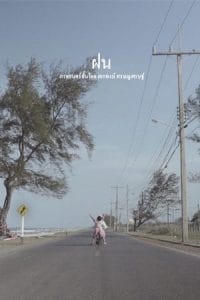
 Director Aekaphong Saransate produced the exquisite short film Fon [Rain] while he was still a film student. The film tackles the issues of family, adolescence, and personal priorities in a mature and subtle manner; it almost feels like a documentary.
See the US Premiere of ‘Fon (Rain)’ on February 25 2018 @6:30pm at Cinema Village (22 East 12th Street) as part of New York City’s 7th Annual Winter Film Awards International Film Festival. Winter Film Awards’s Peter Bell spoke with Aekaphong Saransate about his approach to making his film and what drew him to this subject.
Fon (Rain) was combined with two other similar-themed student works in Lost In Blue, which debuted in his native Thailand in 2016. The trilogy enjoyed great critical success and it is easy to see why. Fon reveals the story of a secret love between Nueng and Fon, two middle-school students. Sarante explores adolescent sexual curiosity and the consequences that can come with acting on one’s primal urges. It is a timeless, universal trope; a coming of age film with the theme of a forbidden, first love. Ever since Shakespeare’s Romeo and Juliet, audiences have been lured by this type of tale because they can relate to it on a personal level. It affords viewers the opportunity for a wistful, nostalgic reminisces. Saransate’s novel twist is the exotic setting of his homeland, Thailand.
Aekaphong Saransate: First I have to thank you for watching my film. Your questions are very interesting.
Peter Bell: My pleasure, it was truly a treat. I found Fon (Rain) to be a well-executed and reflective example of short filmmaking. Tell me about your background and what motivated your choice of topic.
 Aekaphong: I grew up in the South of Thailand. Normally, my father was not the talkative or communicative type of guy. Neither was my mom. When I entered adolescence, my mom was very strict about whom I met. I resented this deeply; one thing that helped me to escape from my situation was cinema. It shows me a different world, different lives and different perspectives. I learned how to live my life by watching movies a lot, and the first movie that opened this alternative world for me was Forrest Gump (1994).
Peter: That drove your choice of topic?
Aekaphong: School and society reinforced my mother’s message that sexual things are bad, but when I was with a girlfriend, my curiosity and instincts as a teenager drove me to want to do intimate things with her. It was very complicated mixture of feelings; desire, love and guilt. It was a lot of pressure and had to be released.
Peter: The film deals with erotic themes and explores them in a voyeuristic manner. Are there any directors whose work you especially enjoy and you aspire towards?
Aekaphong: Shunji Iwai; I really like how he captured the spirit of a teenager in a delicate, soft and gentle way. Naomi Kawase; I like the portrayal of death in her movies. She dealt with it so calmly. Also, Tsai Ming Lieng; I like his way of employing extreme long shots and the essence of loneliness they create.
I always wanted to make a movie with a lot of long shots because I don’t want the audience to get into the story too much. We can be sad but not for a long time because the life still goes on. But in Fon, I wanted to try the classical way before stepping into alternative style.
Peter: The actor’s performances were all so natural. Did you deliberately seek this; were they professionals?
Aekaphong: I think professional actors have a strong characteristic in the real world when they show up on the screen. The audiences already had some background of them in their mind. But for me, I wanted the audiences to know my characters purely from the way they were in my film.
 Peter: Why did you choose the name Rain for your film and one for your main leads?
Aekaphong: Actually, it’s a normal Thai name. I like how Thai people name their children with words that come from nature: Nam (Water), Phukao (Mountain), and Mai (Tree). In my hometown, it’s always raining, more than sunny days. The rain played an important role in my childhood. I remember the days of rain more than the days of sunshine, so when the rain falls down, it recalls for me, some of my memories.
Peter: I very much enjoyed the film’s cinematography and noticed photography and family photos play a key role in the plot of the film. Is photography a hobby? Or were you focused on the importance of memory, family and legacy?
Aekaphong: Taking photos isn’t a hobby, but looking through them is. I grew up in a Chinese family and they always give priority to family. Situations like waiting for members to have meals together, or visiting Qingming Festival together, even the work day were family focused. I think the emphasis of the family importance stemmed from that.
Peter: Did you shoot on actual film?
Aekaphong: No, it was shot by digital camera, a Sony A7S.
Peter: How were you able to get the monkeys to show up in such perfect symmetry for the opening scene?
Aekaphong: It was pure luck. We had finished the shot already and the camera was still on the dolly, then the monkeys came and we suddenly panned the camera, rolled dolly and hit a record button. I think this was the advantage of the small digital camera.
Peter: What was the biggest hurdle of production?
Aekaphong: I think the last scene on the mountain was the hardest scene. We had to shoot outdoors. The sun was burning and there were 5 characters in the scene, which had many details of action-reaction in each dialogue. So, I decided to shoot every character in separate shots because I was so confused and uncontrolled.
Peter: What’s next? More fictional films?
Aekaphong: Right now I’m making a short documentary about my uncle who was murdered in his own house. It’s in the editing process.

Peter Bell
Peter Bell (@PeterGBell25) is a 2016 Master of Arts – Film Studies graduate of Columbia University School of Arts in New York City. His interests include film history, film theory and film criticism. Ever since watching TCM as a child, Peter has had a passion for film, always trying to add greater context to film for others. His favorite films include Chinatown, Blade Runner, Lawrence of Arabia, A Shot in the Dark and Inception. Peter believes movie theaters are still the optimal forum for film viewing, discussion and discovering fresh perspectives on culture. He is currently free lance writing for Vague Visages.
About Winter Film Awards
New York City’s 7th Annual Winter Film Awards International Film Festival runs February 22-March 3 2018. Check out our jam-packed lineup of 93 fantastic films in all genres from 31 countries, including Animation, Drama, Comedy, Thriller, Horror, Documentary and Music Video. Hollywood might ignore women and people of color, but Winter Film Awards celebrates everyone!
Winter Film Awards is an all volunteer, minority- and women-owned registered 501(c)3 non-profit organization founded in 2011 in New York City by a group of filmmakers and enthusiasts. The program is supported, in part, by public funds from the New York City Department of Cultural Affairs in partnership with the City Council and the NY State Council on the Arts.


